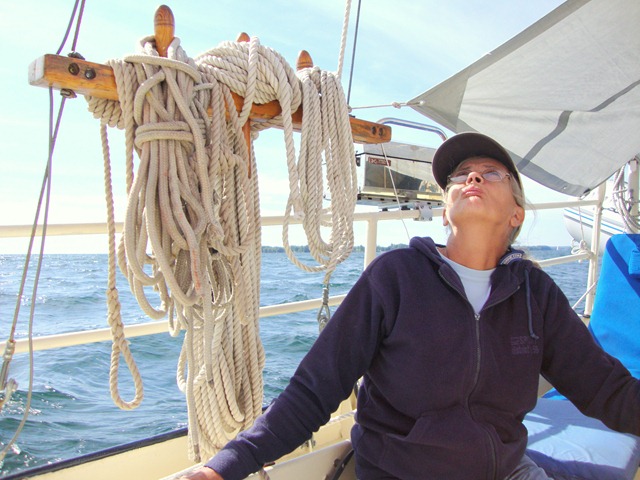
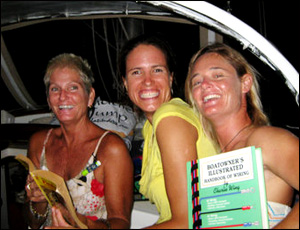
I am not an Admiral. I am a co-captain, a sailor, a cruiser, a wife, and sometimes a wench, but I am not an Admiral.
The word is a title of importance. It denotes authority, oversight and ultimate responsibility for a fleet.
The term has historical context which also imbues it with power. There are many Admirals in the sailing community who were pioneers simply because they, as women, left home and hearth for the open sea.
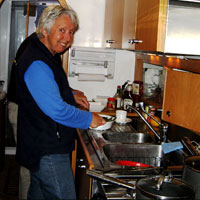
We have a new feature article on Women and Cruising. It arose out of a question we received from Cruising World: Have any of your contributors been involved in a galley refit project? So we asked 12 of our contributors and they responded with a gold mine of practical advice and experience. Following are five simple ideas that Truus Sharp of Key of D shared. You can read all of Truus’ ideas and those of our other 11 contributors in Refitting the Galley: 12 Experiences.
We have not had to do any major renovations to the galley on Key of D because we were very careful to design it to suit us at the outset.
However, we have owned 5 other boats and have a few ideas for some simple things that can be done in almost any galley to make it easier to use.
These are not really “renovations” just the little things that anyone can do quickly and inexpensively. …Read more
NWSA’s 9th Annual Women’s Sailing Conference (a Take the Helm® event) is only two weeks away! Come join us! It will take place Saturday June 5, 2010 at the Corinthian Yacht Club on beautiful Marblehead Harbor in Massachusetts.
Nancy Erley, two-time circumnavigator, calculates that this will be her 6th year at the conference. One year she traveled all the way from London to attend!
Why does she keep coming back as a volunteer instructor?
Nancy says: “I love being with a big group of women who all love what I love – sailing. And this is a very well organized conference at an exceptional venue. “
We asked Nancy to tell us about the workshops she will be giving this year:
This year I’m giving 3 workshops:
1. How to turn your boat around in tight spaces using spring lines:
I’ll show where to tie the line in order to drive against it and spring the boat away from the dock.
We will use a boat at the dock and flip it around every which way with whatever long lines we can find aboard.
We may be tying two dock lines together to get the length we need to turn the boat completely around at the dock without the engine.
As you may know, Women and Cruising co-host Gwen Hamlin each month writes a column for Latitudes and Attitudes magazine called The Admiral’s Angle.
Gwen has a group of “admirals” – women cruisers scattered around the globe who email their input to Gwen on each month’s topic. Gwen and her admirals have been doing this every month now for almost 4 years, and this month we are publishing Gwen’s 44th column!
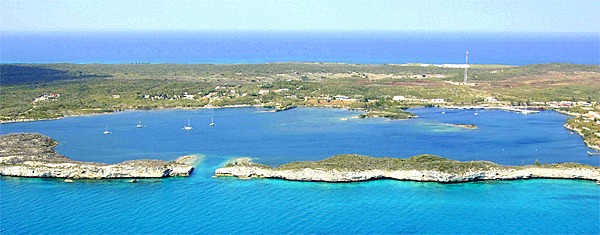
The protected Bahamian harbour we are in with its keyhole-type entrance is adjacent to a very friendly community.
Cruisers stop here in Hatchet Bay, Eleuthera, for short or longer stays and it is a very nice mix of both residents and a few tourists. In other words this place welcomes tourists but does not exist solely for the tourist.
This appeals to both of us, since we do not feel we can truly learn about a place and it’s culture by only visiting the normal tourist spots.
As we were planning to stay for a couple of months, I began looking for an opportunity to volunteer in the community, that was providing free of charge moorings and a safe albeit temporary home.
I have been fortunate indeed to spend two days a week at the local primary school working with kids who are having difficulty in school. The kids are polite, quick to smile and just generally fun to be around. …Read more
I have a new sailing friend, an exceptionally competent woman.
The first day we met, on a beach in the Bahamas, Doris said “I wish I’d understood when we moved aboard how uneven the tasks would seem. I wish I’d understood that my husband’s skills carried more weight than mine.”
That got us talking about how we divvy up chores aboard. Another friend, equally competent, joined us.
Neither Doris, nor Maj-Lis, nor I change the oil. We don’t know how; frankly none of us want to learn. Yet we do our share of chores.
Boat chores, like home chores, fall into categories:
domestic (laundry, cooking, remembering to send birthday cards);
running the boat (navigating, sail trim, helm, anchoring);
ordinary maintenance (polish the fiberglass, teak, brass, etc., clean the bilge, annual inspection of standing rigging, sheets, ground tackle, sails, etc.);
and extraordinary maintenance when something’s going wrong (steering cable replacement, unclog head, fix/replace water pump).
Who does these jobs on your boat? I’d like to report that I can do all those things and that I do them. But I’d be lying. …Read more
It will take place Saturday June 5, 2010 at the Corinthian Yacht Club on beautiful Marblehead Harbor in Massachusetts. (I will be there!)
It’s a full day of learning, sailing, sharing, networking, and good fun. You can participate in a variety of workshops for women of all sailing abilities, presented by some of the best women sailors around. …Read more
We are planning an 8 day catamaran trip to the BVI’s. This is a first sailing trip for my boyfriend and I, and my sis and her hubby. My boyfriend and I love to cook, grill, prepare, etc. My sister and her husband prefer not to bother. So here is my question, do you have some recipes that you could share that are fun and easy to prepare, but may just knock their socks off? What should we take with us that we can not purchase there but are simple to pack?
Any other advice that you have would be appreciated. We depart in just 7 days!
We forwarded Deanna’s question to Gwen Hamlin since she used to run a charter boat in the Virgin Islands. Here is Gwen’s response:
These days, most everything you could want to cook with is available in the Virgin Islands, thanks to the thriving crewed charter industry.
Your choices would be better in the US Virgin Islands, which is where I worked out of, but Tortola is pretty good too.
Road Town is the main city of the British Virgin Islands, and when I was there (a while ago now) there were two big supermarkets and a Gourmet Gallery specialty store catering to the charter boats.
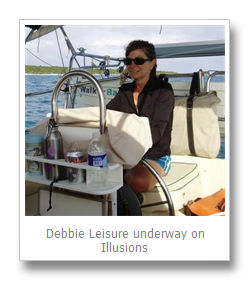
In September of 2009, Debbie Leisure wrote here on the Women and Cruising Blog about how she learned to single-hand her boat after the death of her husband. At the end of the post Debbie said that she planned to sail to the Bahamas this winter. So we recently asked Debbie to update readers – sharing what she has learned on this trip while it is fresh in her mind. Thanks, Debbie!
Yes, I’m sure I learned a lot his winter, my first solo trip to the Bahamas.
I’m also sure that I knew some of these things before setting out for the Bahamas, but I now REMEMBER that I knew them.
Lessons along the ICW
The learning experience did not take long to begin.
I left Oriental, North Carolina in October heading south along the ICW (Intracoastal Waterway) and on my second morning out I ran aground.
Amanda and John Neal (s/v Mahina Tiare) were in the Samoan capital, Apia in September 2009 when a powerful tsunami generated by an undersea earthquake killed dozens and wiped out several villages in the Pacific islands of Samoa, American Samoa, and Tonga. Amanda described their experience in Earthquakes and Tsunamis – Part 1: Amanda Neal reports from Samoa (and Hawaii). Here, in Part 2, she reflects on the experience and offers suggestions for preparing for and responding to earthquake and tsunami alerts.
59% of tsunamis occur in the Pacific with 80% caused by earthquakes
As sailors we need to be aware of the ever present threat of a tsunami.
By establishing emergency procedures for your crew and vessel along with knowing what to expect and do in the event of a tsunami it will be far less likely that you and your crew will become casualties and that your vessel will sustain damage.
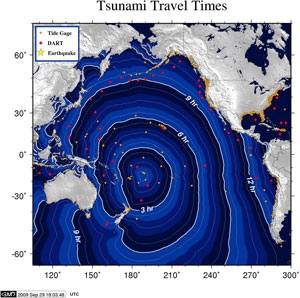
Samoa Tsunami travel times (from the NOAA Pacific Tsunami Warning Center’s website)
Time is the essence.
In the event of an earthquake, time is the essence as there may only be four minutes from the time of the earthquake to the arrival of a tsunami.
Tsunamis travel at 300-600 mph in the deep and open ocean so waiting to see if civil defense alarms sound after an earthquake is not wise.
And Amanda Swan Neal has invited you all to the seminars she will be offering at Strictly Sail.
But that’s not all. There will be over 100 seminars during the show and Women and Cruising contributors will be giving a number of them. Here are 7 more great seminars that Pam Wall, Janna Cawrse Esarey and I will be giving during the show.
Come meet us and let’s talk cruising!
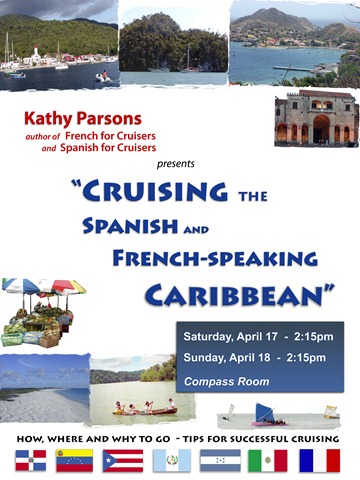
(1) Cruising the French and Spanish-speaking Caribbean
Kathy Parsons Saturday April 17 – 2:15pm
Room: Compass and
Sunday April 18 – 2:15pm
Room: Compass
My first sail was on May 24th 1999, I was 41 years old.
My husband had sailed from the time he was a young boy, starting off in dinghies. We had purchased Thetis, a Halcyon 23, restored her and were now ready to sail.
There was one small problem: her engine was not functioning. A long time sailor and racer told us shove her off the dock and go sailing.
That first day was uneventful, the sailing was nice, and sailing to the dock went well.
Sailing to the dock was something we continued to do even after we had a motor, to keep in practice and because that little boat was so easy to handle.
Do your shopping with Amazon.com through WomenandCruising!
All you need to do is enter the Amazon store through the search box below. We will get a small commission on almost anything you purchase: book, camera or pressure cooker...
(If you have pop-ups disabled in your browser, the Amazon search box may not display for you.)
 I am not an Admiral. I am a co-captain, a sailor, a cruiser, a wife, and sometimes a wench, but I am not an Admiral.
 We have a new feature article on